
Does Hypnosis Work? The Short Answer #
Does hypnosis work? Yes. Hypnosis is a genuine neurological state that has been validated by modern medical imaging. It is not “magic” or purely a placebo effect. Clinical studies, including those performed at Stanford University School of Medicine, verify that hypnosis produces distinct changes in the brain’s electrical activity and connectivity, separating it from both sleep and standard wakefulness.
Does Hypnosis Work in the Brain? The Evidence #
For a long time, hypnosis was dismissed as a “party trick.” However, the introduction of functional MRI (fMRI) scanners changed this. We can now “see” hypnosis happening in real-time, and the answer to “does hypnosis work?” is recorded in measurable brain activity.
A landmark study led by Dr. David Spiegel at Stanford University showed that during a hypnotic trance, three specific things happen in the brain:
- The “Worry Centre” shuts down: Activity decreases in the dorsal anterior cingulate. This is the part of the brain that worries about what you are doing or gets distracted. When this quiets down, you become absorbed in the moment.
- The “Inner Critic” disconnects: There is a reduction in connectivity between the Default Mode Network (DMN) and the executive control centres. The DMN is where your self-consciousness and “rumination” live. When this connection is dampened, you stop overthinking and become open to suggestion.
- Mind-Body Connection increases: Connectivity increases between the brain’s executive control center and the insula (which monitors the body). This explains why hypnosis can physically regulate pain, heart rate, and digestion.
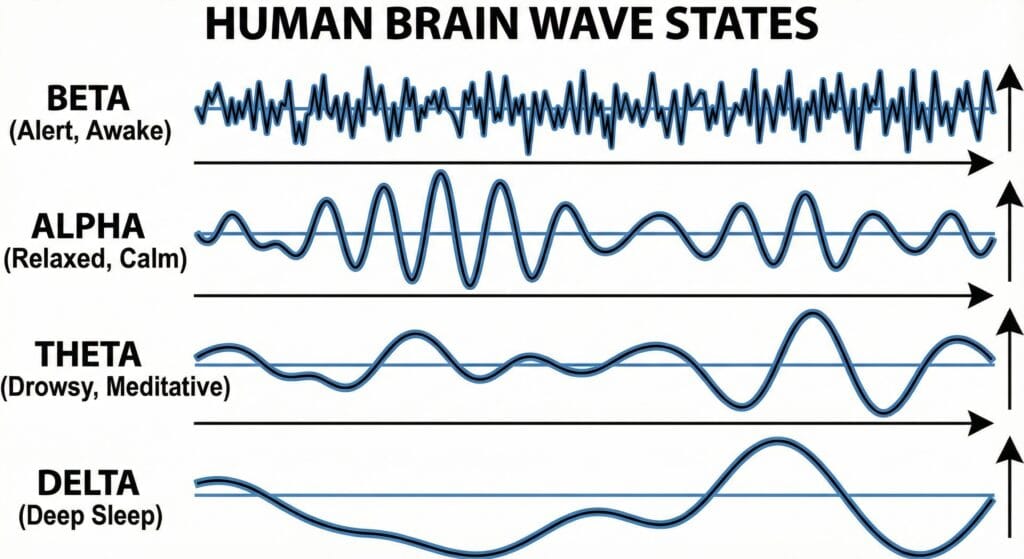
[Image of the brain wave states beta alpha theta delta]
Understanding Brain Waves: The “Theta” State #
Scientifically, we can also measure hypnosis through EEG (electroencephalogram) sensors. As shown in the diagram above, our brains operate at different frequencies:
- Beta (Waking State): Alert, logical, critical thinking. This is where you spend your work day.
- Alpha (Relaxation): Light relaxation, like daydreaming or watching TV.
- Theta (Hypnotic State): This is the target of hypnotherapy. It is a state of deep relaxation but high focus (similar to the “flow state” athletes experience). In Theta, the critical faculty is bypassed, allowing new learning to occur rapidly.
Metaphor: The “Portrait Mode” Effect #
To understand the science without the jargon, imagine the “Portrait Mode” on your smartphone camera.
In normal life (Beta state), your brain is in “Wide Angle” mode. You see everything – the traffic, your phone bill, the person talking next to you. You are easily distracted.
Hypnosis switches your brain into “Portrait Mode.” The background blurs completely. The processing power of your brain is devoted entirely to the subject in the foreground (the therapy). Because the background noise is gone, the image (the suggestion) is captured with crystal clarity.
Common Myth vs. Clinical Reality #
| Common Myth | Scientific Reality |
|---|---|
| “It’s just a placebo effect.” | Incorrect. fMRI scans show physical changes in brain activity during hypnosis that do not occur during the placebo response. |
| “It’s the same as sleep.” | No. EEG scans show that while the body is still, the mind is highly alert and focused. It is a state of “focused attention,” not unconsciousness. |
Key Takeaways: Does Hypnosis Work? #
- Measurable Change: fMRI scans prove that hypnosis alters how the brain processes information and connects different regions.
- Quieting the Critic: It dampens the “Default Mode Network,” which is responsible for self-doubt and overthinking.
- Enhanced Control: Far from losing control, science shows hypnosis increases the brain’s connection to the body, giving you more control over physical sensations (like pain or anxiety).


