
The Short Answer #
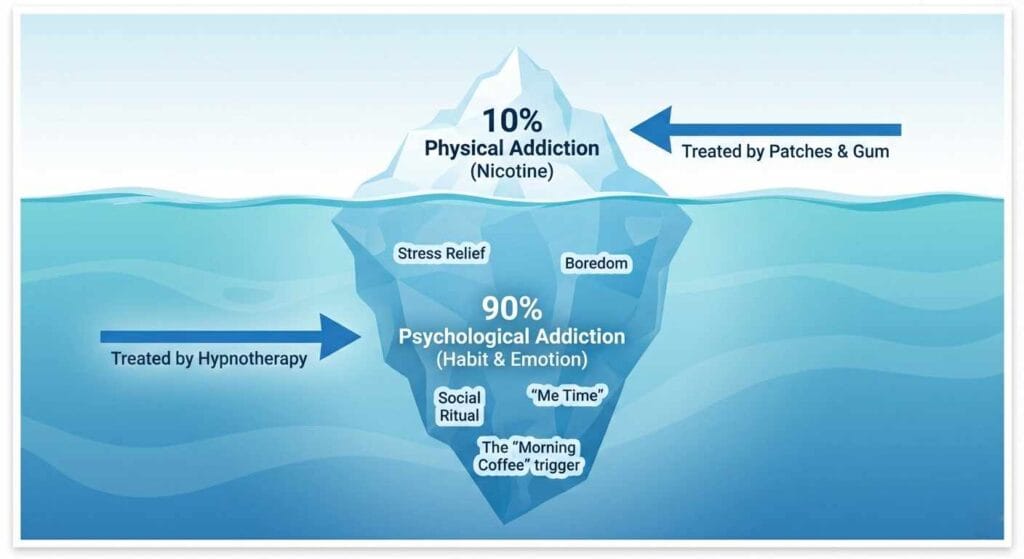
Yes, hypnotherapy is highly effective for smoking cessation because it targets the psychological addiction rather than just the physical dependence. While nicotine patches address the chemical craving, hypnotherapy works to resolve the internal conflict between your conscious desire to quit and your subconscious drive to continue the habit.
How It Works: Rewiring the Habit Loop #
To understand why willpower often fails, we have to look at the brain’s structure. Smoking is rarely just about nicotine; if it were, nicotine patches would have a 100% success rate. Instead, smoking is a “learned behaviour” that has been hardwired into your neural pathways over years of repetition.
The Science of the “Autopilot” #
Your brain is efficient. When you repeat an action (like having a cigarette with coffee) enough times, the brain moves that action from the conscious mind (Prefrontal Cortex) to the subconscious mind. It becomes a script. When you try to quit using willpower, you are fighting a conscious battle against a subconscious script. This creates stress, which ironically triggers the urge to smoke even more.
Hypnotherapy allows us to access that subconscious “scripting” and introduce new instructions. We aim to disrupt the neural pathway that links stress (or boredom/coffee) to the physical act of smoking.
Metaphor: The Glitchy Autopilot #
Imagine your mind is a modern airplane.
- The Conscious Mind is the pilot. The pilot wants to fly to a healthy, smoke-free destination.
- The Subconscious Mind is the Autopilot computer.
Unfortunately, the Autopilot was programmed 10 years ago with a line of code that says: “If stress level is high → Deploy Cigarette.”
No matter how hard the Pilot (You) pulls on the controls to stop, the Autopilot keeps correcting course back to smoking because that is its code. Hypnotherapy is the act of landing the plane, plugging in a laptop, and deleting that line of code so the Pilot and the Autopilot are finally flying in the same direction.
Common Myths vs. Clinical Reality #
| Common Myth | Clinical Reality |
|---|---|
| “Hypnosis will make me forget I ever smoked.” | You won’t get amnesia. Instead, you will remember smoking, but the emotional and physical compulsion attached to the memory is removed. |
| “It’s a magic wand; I don’t need to do anything.” | Hypnosis requires a partnership. It amplifies your intent, but you must have a genuine desire to quit. It cannot force you to do something you secretly don’t want to do. |
| “If I’m hypnotized, I’ll lose control.” | You remain in control the entire time. You are simply in a state of highly focused attention where your mind is more receptive to new ideas. |
Key Takeaways #
- Willpower fatigue: Relying solely on willpower creates internal conflict; hypnosis aims to align your subconscious with your conscious goals.
- Addressing the root: Hypnotherapy tackles the “Secondary Gain” of smoking (e.g., the need for a break or stress relief) and helps find healthy replacements.
- Neuroplasticity: The goal is to weaken the old neural pathways associated with smoking and strengthen new, healthy pathways.


